Bloating After 40: Causes, Relief and When to Worry
By the Wellnyra Editorial Team · This article is for general information and is not medical advice.
Quick answer
Bloating after 40 is common, and it usually has a fixable cause: changing hormones, constipation, gas-producing foods, lactose, swallowed air or irritable bowel syndrome. A two-week food and symptom diary is the fastest way to find yours. But bloating that lasts 2 weeks or more and isn't normal for you is a reason to see a doctor.
Flat stomach in the morning, "five months pregnant" by dinner. If that's your new normal, you're far from alone. The good news is that bloating usually has a cause you can find and fix. The important news is that a small number of cases need a doctor, and we'll show you exactly which ones.

In this article
- Why bloating gets worse after 40
- Bloating or belly fat?
- 7 common causes of bloating after 40
- Find your cause: the 2-week diary
- What helps, and how strong the evidence is
- Does hormone therapy help bloating?
- Why you can look pregnant by evening
- Does menopause bloating go away?
- When bloating is a warning sign
- Frequently asked questions
1. Why bloating gets worse after 40
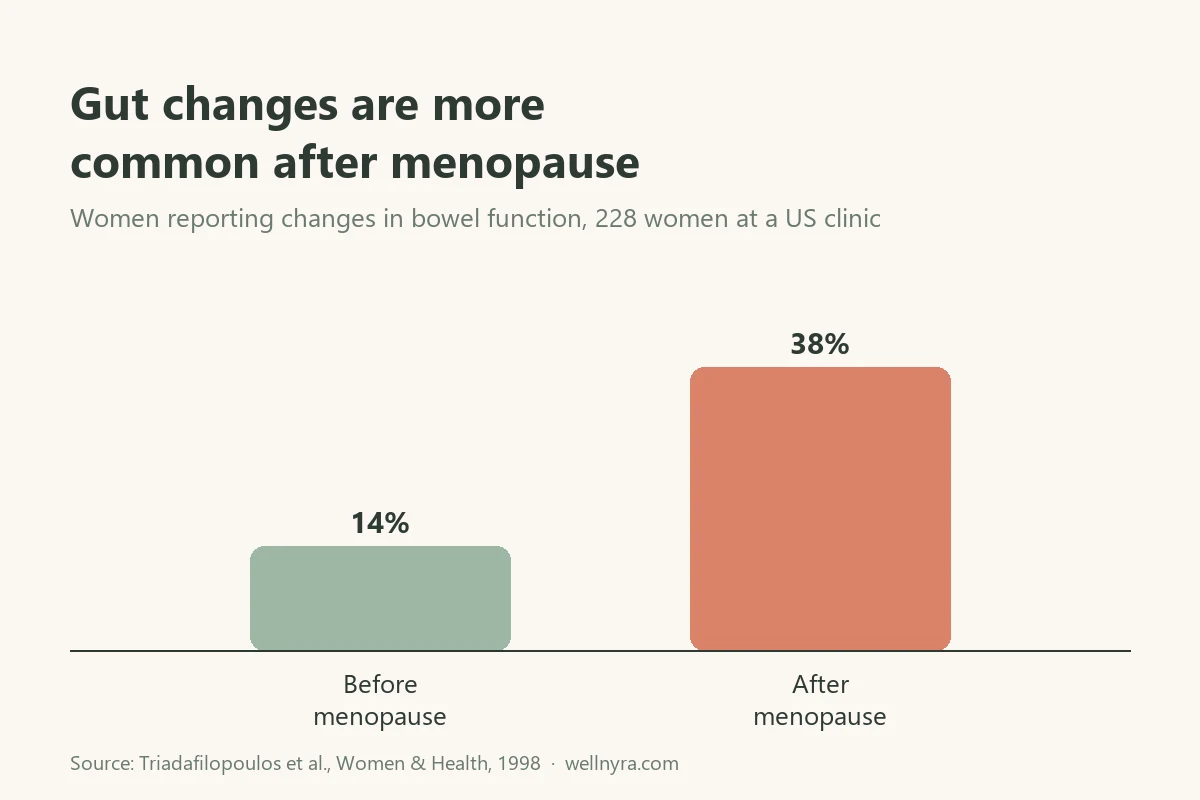
Your gut changes in midlife, and researchers have measured it. In a study of 228 women at a women's health clinic, 38% of postmenopausal women reported changes in their bowel function, compared with 14% of premenopausal women. Irritable bowel-type complaints peaked at 36% in women aged 40 to 49, and nearly half of the postmenopausal women (48%) reported excess gas (Triadafilopoulos et al., 1998).
Hormones seem to play a part. A review of the research found that gut symptoms, including bloating, tend to flare at times when estrogen and progesterone are low or falling, like right before a period and in perimenopause (Heitkemper and Chang, 2009). The authors were careful to say this needs more research, and so are we. Hormones are likely one piece, not the whole story.
Constipation also becomes more common with age. About 16 in 100 US adults have constipation symptoms, rising to about 33 in 100 adults aged 60 and older, and women are more likely to have it than men (NIDDK). When stool sits longer in your gut, gut bacteria have more time to make gas.
2. Bloating or belly fat?
They can look alike in the mirror, but they act differently. Bloating comes and goes: it's usually smaller in the morning, bigger after meals, and feels tight or gassy. Belly fat stays about the same all day and builds up slowly over months. Many women have some of both.
If what you're seeing is steady and doesn't change with meals, our guide to menopause belly fat explains why fat moves to the middle and what studies show actually shrinks it. This article is about the kind that comes and goes.
3. 7 common causes of bloating after 40
Constipation
Doctors usually define constipation as fewer than three bowel movements a week, though what matters most is what's normal for you (NIDDK). Hard stools, straining or the feeling that you didn't finish all count too. If you're bloated and going less often, start here.
Gas-producing foods
Some carbohydrates aren't fully digested in the small intestine, so bacteria in the large intestine break them down and make gas. The NIH lists common ones: apples, peaches and pears; broccoli, cauliflower and other cruciferous vegetables; beans, peas and lentils; milk, ice cream and yogurt; whole wheat; drinks with high-fructose corn syrup; and sugar-free products with sweeteners ending in "-ol," like sorbitol and xylitol (NIDDK). Many of these are healthy foods, so the goal isn't to cut them all. It's to find which ones bother you.
Lactose
About 36% of people in the US have trouble digesting lactose, the sugar in milk, and many people develop it after infancy, so it can show up at any point in adulthood (NIDDK). Bloating, gas and diarrhea after dairy are the classic signs. You may have handled ice cream fine at 30 and not at 45.
Swallowed air
Every gulp of air has to go somewhere. Chewing gum, sucking on hard candy, fizzy drinks, drinking through a straw, eating fast and talking while you eat all add more (NIDDK). If you burp a lot, swallowed air is a likely suspect.
Irritable bowel syndrome (IBS)
IBS is a common gut disorder that causes belly pain along with bloating, diarrhea, constipation or both. In the clinic study above, IBS-type complaints were most common in women in their 40s. If bloating comes with cramping that eases after a bowel movement, it's worth asking your doctor about IBS, because it has specific, well-tested treatments.
A new medication, supplement or fiber
Increasing fiber too quickly can make you gassy at first, which is why the NIH says to add it a little at a time (NIDDK). Some medications can cause stomach symptoms too. For example, MedlinePlus lists stomach pain, constipation and burping among the side effects of semaglutide (Ozempic, Wegovy) (MedlinePlus). If your bloating started soon after something new, tell your doctor. Don't stop a prescription on your own.
Other medical conditions
Celiac disease, small intestinal bacterial overgrowth (SIBO), acid reflux and slow stomach emptying (gastroparesis) can all cause gas and bloating (NIDDK). These need a doctor to diagnose, which is one more reason not to just live with it.
4. Find your cause: the 2-week diary
Every site lists causes. Few tell you how to figure out which one is yours. A simple diary does that, and 2 weeks lines up with how long the CDC says to wait before getting persistent bloating checked.

Every day, write down:
- What you ate and drank, and roughly when.
- Bloating from 0 to 10, in the morning and at night.
- Bowel movements: how many, and whether they were hard or loose.
- Where you are in your cycle, if you still have periods.
- Anything new: a medication, a supplement, a stressful day, a bad night's sleep.
Then look for patterns:
| If you notice... | Look at |
|---|---|
| Bloating on days with few or hard bowel movements | Constipation |
| Bloating a few hours after dairy | Lactose |
| Bloating after beans, broccoli, apples or sugar-free snacks | Gas-producing carbohydrates |
| Lots of burping, worse after fizzy drinks or eating fast | Swallowed air |
| Worse in the days before your period | Hormonal changes |
| Belly pain that eases after a bowel movement | Possible IBS, so talk to your doctor |
Testing lactose at home: if dairy looks guilty, cut out milk, ice cream and soft cheeses for about two weeks and see if bloating improves. Then have a glass of milk and watch what happens. Your doctor can also order a hydrogen breath test if you want a clear answer.
5. What helps, and how strong the evidence is
Plenty of advice online sounds confident and has nothing behind it. Here's what actually has support.
| What helps | Evidence |
|---|---|
| Low-FODMAP diet (for IBS) | Strong: randomized trials and a review of 13 trials |
| More fiber and fluids (for constipation) | Official advice: NIH recommendation |
| Swallowing less air | Official advice: NIH recommendation |
| Light movement after eating | Small study: 8 healthy adults |
| "Anti-bloat" foods, detox teas, "8 glasses of water" | No good evidence we could find |
Low-FODMAP diet, if you might have IBS
FODMAPs are a group of carbohydrates that are hard to digest and easy for gut bacteria to ferment. In a randomized trial, people with IBS who ate a low-FODMAP diet for 3 weeks had less bloating, pain and gas than on a typical diet (Halmos et al., 2014). A review of 13 trials ranked it first among diets for IBS symptoms, including bloating (Black et al., 2022).
Two things most articles leave out. First, it's a three-step process, not a forever diet: you cut high-FODMAP foods for a few weeks, add them back one at a time, then keep only the ones that bother you. Second, it was studied in people with IBS, mostly under specialist care. It's restrictive, so it works best with a dietitian.
Fiber and water, if you're constipated
The NIH recommends 22 to 34 grams of fiber a day for adults, depending on age and sex, added a little at a time, with enough water and other fluids to help it work (NIDDK). Going from 10 grams to 30 overnight is a recipe for more bloating, not less.
Swallow less air
Skip the gum, fizzy drinks and straws, sit down to eat, eat more slowly, and try not to talk with your mouth full. Smaller, more frequent meals can also help (NIDDK).
Take a short walk after meals
In a small lab study, researchers pumped a set amount of gas into the intestines of 8 healthy adults. While they pedaled lightly, more gas moved through and out, and their bellies swelled less than when they rested (Dainese et al., 2004). It's a small study, but a 10-minute walk after dinner is free and has no downside.

What about supplements and probiotics?
The NIH mentions lactase products for people who are lactose intolerant. For other supplements, including probiotics, it advises talking with your doctor first (NIDDK). If you do try one, read the full label, check the research on each ingredient, and give it a fair trial while you keep your diary going, so you can tell if it's actually helping.
6. Does hormone therapy help bloating?
You'll find sites saying hormone therapy fixes bloating and others saying it makes it worse. The evidence is thin either way. In the clinic study above, women using estrogen had the same gut symptoms as women who weren't (Triadafilopoulos et al., 1998). If you notice bloating after starting or changing hormone therapy, tell your doctor rather than stopping on your own. Hormone therapy isn't prescribed for bloating.
7. Why you can look pregnant by evening
Doctors separate two things that usually happen together. Bloating is the feeling: trapped gas, pressure, fullness. Distension is when your belly actually gets bigger, enough to measure (Lacy et al., 2021). That's why your waistband can fit at breakfast and dig in by dinner. Food, fluid and gas build up through the day, and the belly wall pushes out to make room.
If your belly goes back down overnight, that pattern points to bloating and distension, not fat. If it stays swollen for days, feels hard, or keeps growing, see a doctor.
8. Does menopause bloating go away?
We couldn't find a study that tracks how long midlife bloating lasts, so we won't give you a made-up timeline. What the research does show is that bowel changes were more common after menopause than before it in the clinic study above. So waiting it out isn't a great plan. The more useful question is what's causing yours. Constipation, lactose, swallowed air and IBS all improve once you treat them, at any age.
When bloating is a warning sign
Most bloating is harmless. But bloating is also on the CDC's list of signs of ovarian cancer, and it's easy to brush off because it feels so ordinary. The CDC says to see a doctor if you have any of these for 2 weeks or longer and they're not normal for you (CDC):
- Bloating
- Feeling full too quickly or trouble eating
- Pain or pressure in your pelvis, or belly or back pain
- Needing to urinate more often or more urgently, or constipation
Also talk to your doctor if:
- You have unusual vaginal bleeding, especially after menopause. The CDC says to see a doctor right away for that.
- You're losing weight without trying, or you see blood in your stool.
- Your symptoms changed suddenly, or come with diarrhea, constipation or belly pain (NIDDK).
- Bloating started after a new medication or supplement.
Start with your primary care doctor or gynecologist. Tell them how long it's been going on and bring your diary. That's exactly the information they need.
Frequently asked questions about bloating after 40
References: Triadafilopoulos et al., Women Health 1998, Heitkemper and Chang, Gend Med 2009, Halmos et al., Gastroenterology 2014, Black et al., Gut 2022, Dainese et al., Am J Med 2004, Lacy et al., Clin Gastroenterol Hepatol 2021, NIDDK: Gas, NIDDK: Constipation, NIDDK: Lactose Intolerance, MedlinePlus: Semaglutide, CDC: Ovarian Cancer Symptoms.